
The Reality Children Face
Understanding the Challenge
Disability in Zambia
An estimated 4.4% of children in Zambia live with disabilities and are among the country’s most vulnerable. Limited healthcare, widespread poverty, and a lack of inclusive infrastructure leave many children without access to the mobility aids and support they need. For families in rural communities, appropriate wheelchairs are often unavailable, unaffordable, or unsuitable for local conditions.
Without mobility support, many children spend their days on the ground or being carried by caregivers. This impacts their physical development, wellbeing, and ability to attend school, while stigma and misunderstanding can lead to isolation from community life.
Disability and poverty are closely connected. Families often face significant financial and caregiving burdens, and when a child requires constant support, a parent may be unable to work. Many families describe lives marked by exhaustion, uncertainty, and limited opportunities. It is in this context that Blu Spring’s work begins.
Blu Spring in Figures
To children with disabilities throughout Zambia
Conducted to repair and adjust wheelchairs to ensure optimal fit and function
Given to train local healthcare workers and technicians to fit and repair wheelchairs.
Who help us with wheelchair distribution and maintenance throughout Zambia.
Supporting girls staying in school and women continuing to work with dignity
Our desire for lasting impact
Creating Lasting Change Through Mobility
In Zambia, an estimated 120,000-140,000 children are living with disabilities, and many grow up without the support they need to thrive. A significant number of children with severe disabilities, conservatively estimated between 30,000 and 50,000, require assistive devices such as wheelchairs, yet most still do not have access to them.
Through our wheelchair distribution program and healthcare provider workshops, we aim to create measurable, sustainable improvements in children’s lives and strengthen local capacity for disability care. Our work is guided by one central question: What meaningful change happens when a child gains mobility?
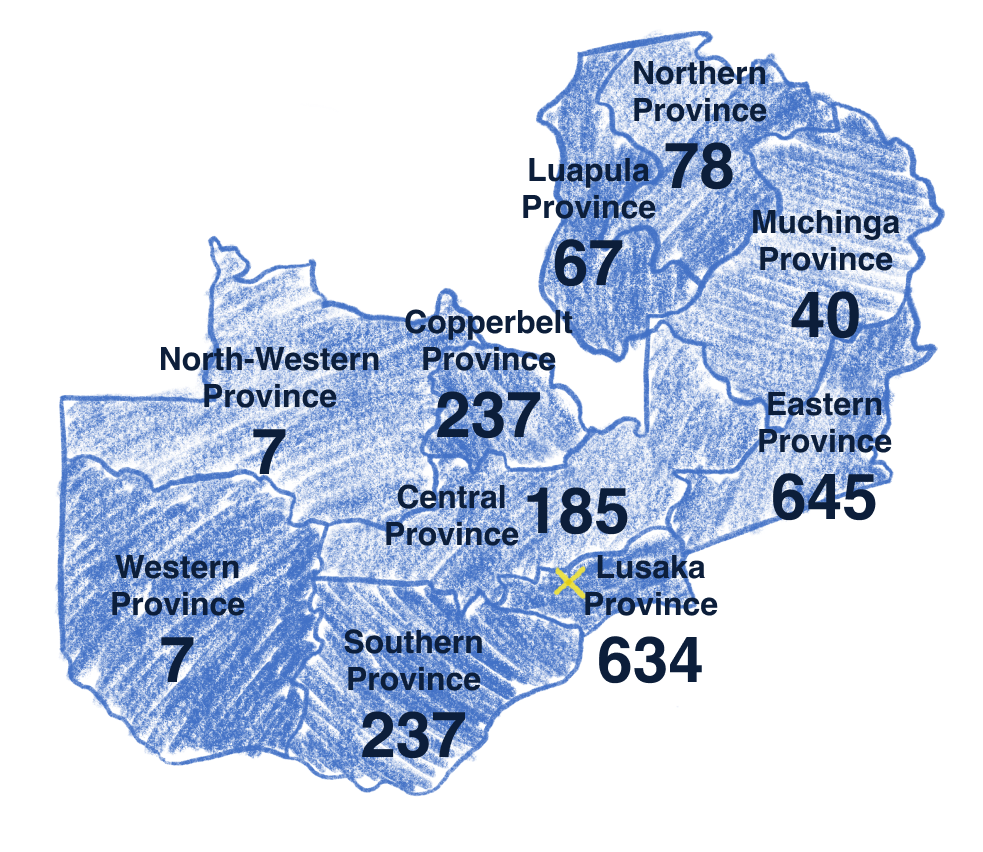
Number of BluSpring Wheelchairs in Zambia Per Province
Measured Impact
How Wheelchairs Change Lives
Child Health and Physical Wellbeing
A properly fitted wheelchair improves posture, comfort, and safety. Children experience fewer pressure sores, better spinal alignment, and greater physical support, while assisted sitting and movement help build strength and support long-term development.
Improvements in:
Additionally, spending their days in a seated position enables children to interact with their surroundings and develop cognitively in a way which was previously impossible.
Education and School Attendance
Mobility opens the door to education. With a wheelchair, children can attend school, participate in class, and learn alongside their peers. Families and teachers often report increased confidence, improved engagement, and greater hope for the future.
Community Participation and Inclusion
Wheelchairs give children greater independence and inclusion within their communities. As children become more visible and active in daily life, stigma is challenged, friendships grow, and participation replaces isolation.
Improvements in:
Community Participation and Inclusion
When children gain mobility, caregivers are freed from the physical demands of carrying them, creating more time for work, household responsibilities, and income-generating activities. Families often experience reduced stress, improved wellbeing, and greater financial stability.
Care-Givers found improvements in:
Over the years
Impact in numbers
Since the beginning of our wheelchair program, Blu Spring has shipped multiple containers of specialized, child-sized wheelchairs to Zambia in partnership with Wheelchairs for Kids Australia.
2018
Wheelchairs Delivered
162
Follow ups Conducted
82
2019
Wheelchairs Delivered
290
Follow ups Conducted
105
Wheelchair Workshops
2
2020
Wheelchairs Delivered
127
Follow ups Conducted
58
Distributed Covid Packs
110
2021
Wheelchairs Delivered
265
Follow ups Conducted
160
2022
Wheelchairs Delivered
362
Follow ups Conducted
155
2023
Wheelchairs Delivered
342
Follow ups Conducted
243
Wheelchair Workshops
2
2024
Wheelchairs Delivered
350
Follow ups Conducted
510
Wheelchair Workshops
2
2025
Wheelchairs Delivered
276
Follow ups Conducted
490
Wheelchair Workshops
1
Equipping local healthcare communities
Strengthening Impact Through Healthcare Workshops
Providing equipment alone is not enough. Through workshops for caregivers, healthcare workers, technicians, and community volunteers, Blu Spring shares practical knowledge on wheelchair fitting, posture support, and follow-up care. This strengthens local expertise while empowering caregivers to play an active role in supporting children with disabilities.
By building knowledge, skills, and confidence within local communities, Blu Spring helps create a sustainable, locally driven system of disability care that continues long after a wheelchair is delivered.